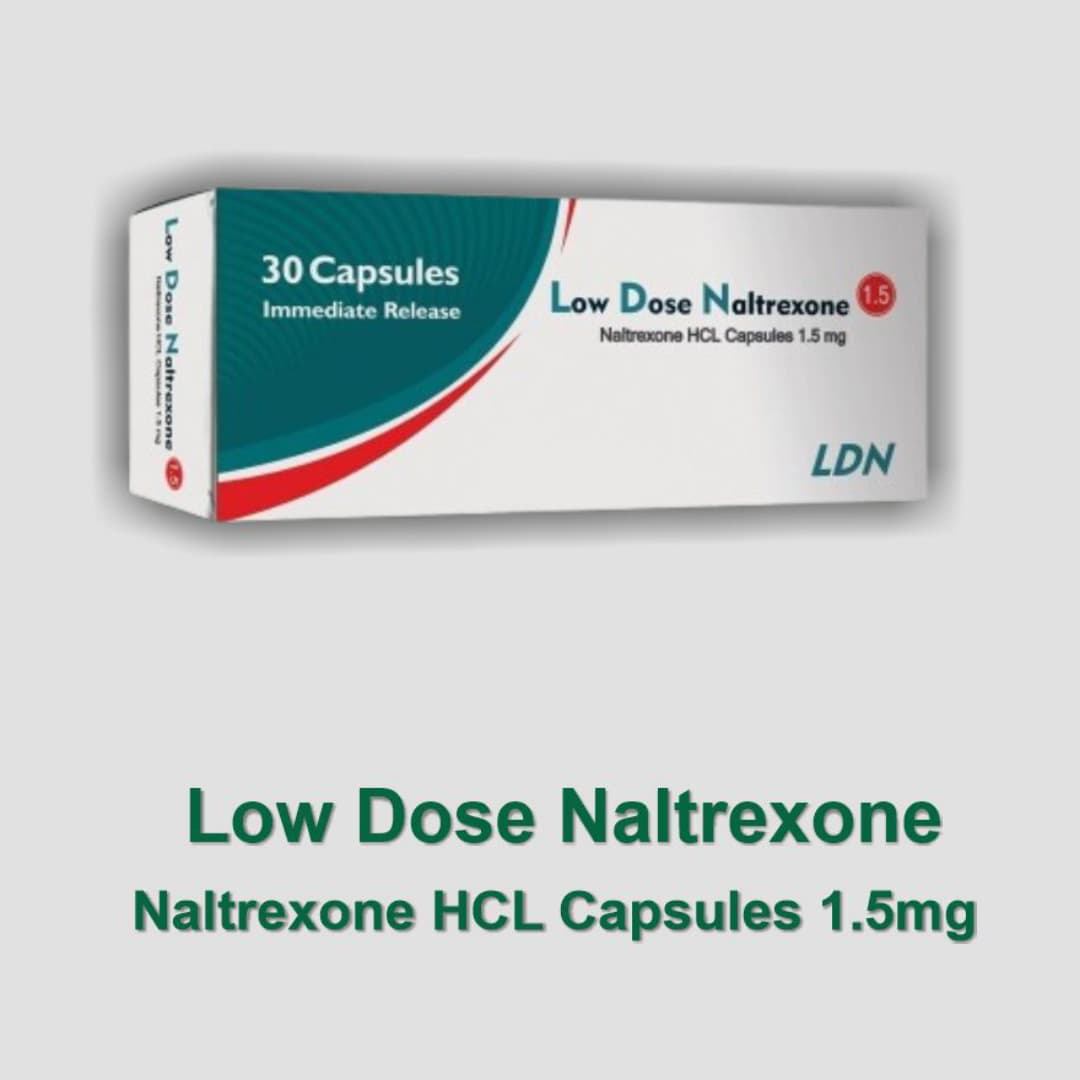
$63.00 – $178.00Price range: $63.00 through $178.00
Generic name – Naltrexone 1.5mg
Brand name – Low Dose Naltrexone (LDN) 1.5 mg
Packaging – 30 Tablets in 1 Box
Delivery Time – 6 To 15 Days.
Low Dose Naltrexone (LDN) 1.5mg is a compounded or specially formulated oral tablet that contains Naltrexone Hydrochloride at a significantly reduced dose compared to its standard clinical use. Originally, the FDA approved Naltrexone at doses of 50mg for the treatment of opioid and alcohol dependence. However, when doctors prescribe it at much lower doses — typically between 1.5mg and 4.5mg — it produces a distinctly different set of pharmacological effects that benefit patients with chronic pain, autoimmune diseases, and inflammatory conditions.
At 1.5mg, Naltrexone does not suppress the opioid system in the way that the standard 50mg dose does. Instead, it briefly and transiently blocks opioid receptors. As a result, the body responds by producing a compensatory increase in endorphin levels and by modulating immune system activity. This makes LDN 1.5mg a unique and increasingly researched option in the management of conditions where inflammation and immune dysregulation play a central role.
Because LDN exists outside the scope of standard mass-market pharmaceutical manufacturing, licensed compounding pharmacies typically prepare it to individual prescriptions. Consequently, the quality, excipients, and formulation may vary between compounding providers. Patients should always source LDN from a regulated and accredited compounding pharmacy under the guidance of a qualified prescriber.
| Detail | Information |
|---|---|
| Medicine Name | Low Dose Naltrexone (LDN) |
| Active Ingredient | Naltrexone Hydrochloride 1.5mg |
| Drug Class | Opioid Antagonist (at low dose: Immune Modulator) |
| Primary Use | Autoimmune conditions, chronic pain, inflammation |
| Form | Oral Tablet (or Capsule, depending on compounder) |
| Typical Dose Range | 1.5mg to 4.5mg |
| Onset of Therapeutic Effect | Several weeks of consistent use |
| Prescription Required | Yes |
LDN 1.5mg works through a mechanism that differs fundamentally from standard-dose Naltrexone. Understanding this distinction is essential, because the low-dose effect operates through two complementary pathways that together modulate the immune system and reduce systemic inflammation.
Step 1 – Brief receptor blockade occurs. After ingestion, Naltrexone 1.5mg binds to opioid receptors in the brain and body for a short period, typically 4 to 6 hours. During this window, it temporarily blocks these receptors from responding to naturally occurring endorphins.
Step 2 – The brain detects a perceived endorphin deficiency. Because the receptors are briefly blocked, the brain interprets this as a shortage of endorphins. In response, it actively upregulates the production of endogenous opioids, including beta-endorphin and met-enkephalin.
Step 3 – Endorphin levels rise above baseline. Once the Naltrexone clears from the system — which it does quickly at such a low dose — the opioid receptors become free again. At this point, the elevated endorphin levels bind to the now-unblocked receptors, producing a sustained analgesic and immune-enhancing effect throughout the following day.
Step 4 – Naltrexone acts on glial cells in the central nervous system. Research indicates that Naltrexone also binds to Toll-like receptor 4 (TLR4) on microglial cells — the immune cells of the central nervous system. This binding directly reduces microglial activation, which is a key driver of neuroinflammation.
Step 5 – Pro-inflammatory cytokine production decreases. By inhibiting microglial overactivation, LDN suppresses the release of pro-inflammatory cytokines such as TNF-alpha, IL-6, and IL-12. Consequently, overall systemic inflammation decreases, which explains its therapeutic relevance in autoimmune and inflammatory conditions.
Step 6 – Immune balance is restored. Over time and with consistent nightly dosing, LDN gradually shifts the immune system from an overactive, pro-inflammatory state toward a more balanced and regulated response. This is why patients typically need several weeks of continuous use before they notice significant improvements.
Recommended Starting Dose: 1.5mg orally, once daily at bedtime
| Instruction | Detail |
|---|---|
| Starting Dose | 1.5mg at bedtime |
| Titration Schedule | Increase gradually to 3mg, then 4.5mg as directed by doctor |
| Time of Administration | Bedtime (between 9 PM and midnight for optimal effect) |
| With or Without Food | Either; food does not significantly affect absorption |
| Maximum Commonly Used Dose | 4.5mg per day |
| Prescription Required | Yes — always use under medical supervision |
Most prescribers begin patients at 1.5mg nightly for the first two to four weeks. This cautious approach allows the body to adjust gradually and minimises the likelihood of early side effects such as vivid dreams or sleep disturbance. After this initial period, the doctor may increase the dose to 3mg for a further two to four weeks. Subsequently, if the patient tolerates it well, the dose increases again to the commonly accepted therapeutic ceiling of 4.5mg nightly.
Patients who currently take opioid medications must not use LDN, as Naltrexone directly blocks opioid receptors and will precipitate immediate withdrawal symptoms. Furthermore, individuals with thyroid conditions — particularly those on thyroid hormone replacement therapy — should monitor their thyroid levels closely, as LDN can enhance thyroid function and may require medication adjustments. Always disclose all current medications to the prescribing physician before starting LDN.
The majority of patients tolerate LDN 1.5mg very well, particularly during the early titration phase. Nevertheless, some users do experience the following effects, most of which resolve within the first two to four weeks of treatment:
Since these effects are dose-dependent and typically transient, starting at 1.5mg and titrating slowly minimises their occurrence significantly. In many cases, patients who initially experience sleep disturbance find that shifting the dose to earlier in the evening resolves the problem.
Although serious adverse effects at the 1.5mg dose are uncommon, patients must remain aware of the following important contraindications and risks:
Q1: What conditions does Low Dose Naltrexone 1.5mg treat? Doctors prescribe LDN 1.5mg for a wide range of conditions where immune dysregulation and chronic inflammation play a central role. These include multiple sclerosis (MS), fibromyalgia, Crohn’s disease, lupus, rheumatoid arthritis, chronic fatigue syndrome (ME/CFS), Hashimoto’s thyroiditis, and certain chronic pain syndromes. Furthermore, ongoing research is exploring its potential in oncology and long COVID management.
Q2: How long does Low Dose Naltrexone take to work? Unlike fast-acting medications, LDN does not produce immediate results. Most patients begin to notice improvements after four to twelve weeks of consistent nightly use. Since LDN works by gradually rebalancing the immune system and increasing endorphin production, the therapeutic process takes time. Therefore, patience and consistent adherence to the prescribed regimen are essential for achieving optimal results.
Q3: Can someone take LDN alongside other medications? LDN interacts with several drug classes, so a full medication review is always necessary before starting treatment. Most importantly, it must never combine with opioid medications of any kind. Additionally, patients on immunosuppressants, thyroid medications, or certain antidepressants should discuss potential interactions with their doctor before use.
Q4: Does Low Dose Naltrexone cause addiction or dependence? No. LDN does not cause addiction, physical dependence, or tolerance in the way that opioid medications do. Because the dose is so small and the receptor blockade so brief, the body does not adapt in ways that lead to dependency. Patients can discontinue LDN without experiencing withdrawal symptoms, though they should always consult their doctor before stopping.
Q5: Why do doctors recommend taking LDN at bedtime? Prescribers recommend taking LDN at bedtime because the body naturally produces the highest levels of endorphins between 2 AM and 4 AM. By taking LDN in the evening, the transient receptor blockade coincides with this peak production window. Consequently, the subsequent rebound surge in endorphins — which occurs once the Naltrexone clears — is maximised during the early morning hours, producing the most effective therapeutic response.
Q6: Is Low Dose Naltrexone the same as standard Naltrexone 50mg? No. Although both products contain the same active ingredient, they work in fundamentally different ways. Standard Naltrexone 50mg provides sustained, full opioid receptor blockade and is used specifically for opioid and alcohol dependence. LDN 1.5mg, by contrast, produces only a brief and partial blockade that triggers an immune-modulating rebound effect. Therefore, the two products serve entirely different clinical purposes.
Q7: Can LDN help with weight loss? Some research suggests that LDN may support weight management indirectly by improving metabolic function, reducing inflammation, and modulating appetite-related hormones. However, LDN is not currently approved or specifically indicated as a weight loss treatment. Patients interested in this application should discuss it with their doctor and consider it only as part of a broader, medically supervised weight management plan.
Q8: Where can someone buy Low Dose Naltrexone 1.5mg? Because standard pharmaceutical manufacturers do not produce LDN at the 1.5mg dose, licensed compounding pharmacies prepare it to individual prescriptions. Patients must obtain a valid prescription from a qualified healthcare provider and then source the medication from a reputable, regulated compounding pharmacy. Purchasing LDN from unverified online sources carries significant risks related to quality, purity, and safety.
Unlike conventional immunosuppressant drugs that broadly dampen the immune response, LDN 1.5mg takes a fundamentally different approach. Rather than suppressing immunity, it actively recalibrates immune function by reducing overactivation. Consequently, patients benefit from reduced inflammation without the heightened infection risk that immunosuppressive therapies typically carry.
Research interest in LDN has expanded significantly over the past two decades. Clinical trials and observational studies now cover its applications in multiple sclerosis, fibromyalgia, Crohn’s disease, and various autoimmune disorders. As a result, an increasing number of physicians are incorporating LDN into their treatment protocols, particularly for patients who have not responded adequately to conventional therapies.
Because Naltrexone has been in clinical use at 50mg for decades, its safety profile is extensively documented. At the much lower 1.5mg dose, the side effect burden decreases substantially. Furthermore, since LDN does not cause organ toxicity, immunosuppression, or dependency, it represents a considerably safer long-term option than many available alternatives for chronic conditions.
Compared to biologic medications — which can cost thousands of pounds or dollars per month — LDN compounding costs remain relatively modest. This makes it a highly accessible treatment option for patients managing long-term chronic conditions, particularly those without comprehensive insurance coverage for expensive specialty medications.
The simple once-daily dosing schedule, taken at bedtime, integrates easily into daily life without disrupting routines. Unlike medications that require multiple daily doses or careful timing around meals, LDN demands minimal lifestyle adjustment while delivering consistent therapeutic benefit over time.
Many patients with chronic autoimmune conditions require long-term treatment. LDN is well-suited to this need because it does not produce tolerance — meaning the same dose continues to produce the same effect over months and years of use. As a result, patients do not require escalating doses to maintain their therapeutic response.
For many patients with fibromyalgia, ME/CFS, or treatment-resistant autoimmune disease, conventional medications provide insufficient relief or carry unacceptable side effects. LDN therefore offers a meaningful alternative pathway, and its off-label use continues to grow precisely because patients and practitioners alike report significant quality-of-life improvements that other treatments fail to deliver.
Always consult a licensed healthcare professional before starting, stopping, or adjusting any medication. This content serves informational purposes only and does not constitute medical advice. LDN is a prescription-only medication in most jurisdictions and must be used exclusively under qualified medical supervision.
 Alcohol De Addiction
 Alcohol De Addiction
Explore Medicines
Select Using Category